
Lock & Key / Trustpilot
Continue to our homepageThirteen years.
One question.
Seven days.
Trustpilot told us we needed them. We asked why. We checked the pitch, took back our review invitations, and replaced their paid widgets.
Then the threats started.
The receipts · 29 September 2026
01 · Get them dependent
How Trustpilot traps small businesses.
The pitch is seductive: send your customers here. The renewal pitch leans on something else entirely: look how much of your reputation now lives here. How comfortable are you walking away?
Trustpilot’s Automatic Feedback Service (AFS) emails customers asking for a review. Angry customers already have a reason to complain. Happy customers often need asking. Get more of those happy customers to speak up and your score can go up.[1]
The research · four retailers
Up to +0.5
Stars higher from customers asked by email than from those who reviewed without being asked.
Our export · five weeks in May
43 out of 43
Reviews came from automatic invitations. Our TrustScore: 4.9.
We had a 4.9. We still make mistakes. A high score tells you who left a review, as well as how good the business is. Even buyers can get suspicious when a score looks too perfect.[2]
Invitations can boost your score. Trustpilot charges for sending more of them. The company publishing your score also sells you the tools that can help lift it.
02 · Make leaving hurt
Lock the door.
Cap free invitations at 50 a month. Put higher volumes and review displays into paid plans. Add contracts that usually run for twelve months, renew automatically, and require 30 days’ notice to stop renewal.[3]
We asked for a cheaper deal covering the review boxes. Trustpilot’s answer:
“our widgets are not available as a standalone subscription.”
We asked for API access to run our own invitations and build our own widgets. Their proposed package:
£9,039.60a year, plus VAT. Advanced plan + API.
Our staff earned those nineteen thousand reviews. Our customers wrote them. Now Trustpilot was using that mountain of goodwill to sell us a nine-grand package.
The case for keeping us paying
Their claims.
We asked Trustpilot what we were getting for the money. They reached for AI research and enormous traffic figures. So we opened the study, checked our dashboard, and read the small print on those numbers.
Exhibit A
The sales pitch · 27 May 2026
The study said something else.
To sell us on staying, Trustpilot claimed that 58% of consumers now use AI instead of Google search. More than half of consumers abandoning Google would be quite a story. So we read the study.
Trustpilot’s email
58%
“58% of consumers now use AI (ChatGPT, Gemini) instead of traditional Google search.”
Capgemini’s study
58%
Replacing search engines with GenAI for product and service recommendations.
Delete what the research is about, and suddenly you have a much bigger sales claim. We challenged it. No correction appears in the email chain.[5]
The same email said an active Trustpilot profile made us “3x more likely” to be recommended by AI. The cited research did not establish that paying caused that benefit. Our own dashboard analysis recorded one ChatGPT-attributed website click in 180 days. A grand story about AI still left the price unexplained.
Exhibit B
After we cancelled · 24 June 2026
They tried to sell us our own traffic.
474,000
Page loads on our website featuring a TrustBox.
440,000
Views of reviews and ratings on our website.
“These figures demonstrate the increased exposure and value your Trustpilot presence is delivering to potential customers.”
Our website loaded their widget. They counted the loads and presented them as value delivered. You do not get to claim the shop’s footfall because your sign is by the till.
Neither number measured customers or sales they brought us. As we put it in our reply: We are providing visibility to Trustpilot
.
03 · We found the way out
We built an exit. Out came the warning.
We took back our invitations and built our own Google review display. On 16 September, we asked Trustpilot to confirm the old TrustBoxes were no longer contacting its service. Twelve days later:
“Make the necessary changes within 7 days.”
The notice said further use outside its guidelines could mean a warning and a
consumer alert on your business profile.
A deadline. A possible public warning. The original notice did not identify a specific offending page, image or widget. Remarkably precise about the consequences; remarkably vague about the offence.
We pushed back. Our star was a licensed Font Awesome icon. Our review display used Google. We asked them to identify the asset they claimed to own and the right we had supposedly infringed. Sending the threat should be the part that comes after doing that homework.
04 · The warning went live · 29 September 2026
We asked for evidence. They put up a banner.
Trustpilot’s reply called out our display referencing 19,000+ reviews
and alleged unauthorized use of Trustpilot branding
. It did not explain why the licensed Font Awesome star we had identified was theirs, or answer our request for the specific asset and right we had infringed.
“we will proceed with the warning and the placement of a Consumer Alert on the Trustpilot profile”
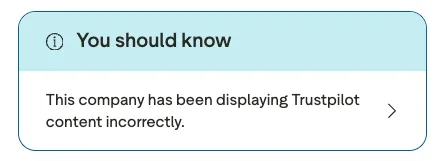
And they did. This is what customers now see:
We dispute that allegation. We explained where our icon came from. We asked them to substantiate their claim. Their answer to our customers is a warning about us.
Apparently, publishing the accusation was easier than answering the question.
We refuse to rent our reputation.
We took back the invitations, replaced the widgets, and refused the renewal. Google review requests cost us £0 in platform fees. Our website display is our own work. Trustpilot’s sales pitch depended on us needing them. We don’t.
Misrepresent a study. Dress up our traffic as your value. Then put a public warning on our reputation while our request for evidence goes unanswered. That is a rotten way to sell trust.
Read the sources
1. Invitations and ratings. Askalidis and Malthouse’s study of four retailers found email-prompted reviewers gave ratings up to 0.5 stars higher. This was research on retailer invitations, not a test of Trustpilot AFS or a measurement of its effect on our score. Karamana’s Management Science study found solicitation made rating distributions more representative; both solicited and unsolicited reviews overstated average private satisfaction. Our 43 reviews and 4.9 score were recorded in our 29 May email, original thread, p. 13.
2. Near-perfect ratings. Northwestern’s Spiegel Research Center found product purchase likelihood typically peaked at ratings between 4.0 and 4.7, then fell towards 5.0. This does not establish an ideal score for our business or that any particular 4.9 is false.
3. The limits and the contract. Trustpilot confirms AFS is available on Free with 50 monthly invitations. Its paid plans offer higher limits. Its published terms, sections 6 and 35, describe usual twelve-month terms, automatic renewal and 30 days’ notice for direct subscriptions, subject to the agreed commercial terms.
4. Our correspondence and the price. Trustpilot refused standalone widgets on 10 June (original thread, p. 12), then offered Advanced at £495 plus VAT a month and API at £258.30 plus VAT a month: £753.30 monthly, billed quarterly, or £9,039.60 annualised (pp. 7 and 10). The £9,039.60 was a proposed combined package, not our existing bill or a widget-only price. Cancellation was requested on 10 June and confirmed on 11 June. On 11 and 17 June, Trustpilot recommended continuing its automatic invitations (pp. 8 and 11).
5. The AI pitch. Email of 27 May, original thread, p. 18; our dashboard analysis and challenge, pp. 12–15. Capgemini’s 58% finding concerns product and service recommendations. Our original reply wrongly suggested it had not used “replaced search engines” language; it had, in that specific context. Seer’s research compared profiles with different activity levels; it did not establish that paying caused the reported benefits. Referral clicks and AI recommendations are different measures.
6. Our traffic. Trustpilot’s email of 24 June, original thread, pp. 5–6, defined the 474,000 impressions and 440,000 views over six months as activity on our site. The excerpt from our reply is dated 5 August, p. 2.
7. The warning. Our 16 September reply is on p. 1 of the original thread. The separate brand-notice thread contains Trustpilot’s 28 September notice (p. 2) and our 29 September reply (p. 1). The notice gave examples of misuse without identifying a specific instance on our site. The dates establish the sequence, not Trustpilot’s motive. Both email threads are retained by Lock & Key; full copies contain personal contact details and are not published here.
8. The live alert. In its 29 September 2026 reply at 3:31pm, Trustpilot alleged unauthorised branding and specifically referenced our 19,000+ review display. It said we had not confirmed that we would remove or amend it and that it would proceed with a Consumer Alert. Our earlier reply that day had identified the icon as licensed Font Awesome artwork and requested the specific asset, intellectual property right and evidence behind the allegation. The reply did not supply those details. The screenshot above records the warning subsequently displayed on our profile. We retain the correspondence; personal contact details are not published here.
Where we stand. As of 29 September 2026, our paid plan is due to end on 10 October. Our public profile and reviews remain on Trustpilot, our site links to them, and limited invitations continue there. Our alternative uses Google review links and our own development work. We will publish corrections or a substantive response from Trustpilot here.