


Lock & Key / Trustpilot
Continue to our homepageThirteen years.
One question.
Seven days.
Trustpilot told us we needed them. We asked why. We checked the pitch, took back our review invitations, and removed their paid widgets.
Then the threats started.
The receipts · Display updated 22 October 2026
Update · Notice sent 18 October 2026
A cease-and-desist notice. For this.
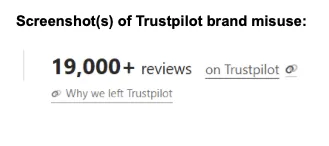
On Sunday 18 October, Trustpilot sent us a cease-and-desist notice. Its evidence is the screenshot above: “19,000+ reviews”, a separate link to our profile, and a link explaining why we left.[12]
No TrustScore. No star rating. No review quotes. No Trustpilot logo.
Its instruction: remove our own implementation and use an authorised TrustBox instead.
Seven days to comply. Otherwise, Trustpilot says it will put a prominent warning on our profile for at least six months, hide our TrustScore and stop sharing our review data with search engines.
How did thirteen years of trusting them with our customers’ reviews end here?
Start with how the door opens.
01 · Get them dependent
How Trustpilot traps small businesses.
You do not even have to sign up. Trustpilot says a business profile can be created automatically when someone searches for a business’s web address. Once reviews arrive, it generally will not delete the page just because the business wants out.[10]
Look at Apple: 1.7 out of 5. Google: 2.3. Both profiles were unclaimed when we checked. Both carried Trustpilot’s warning that, without customer invitations, reviews may not be representative. Would you reduce everything you know about Apple to 1.7 stars?
Apple has a reputation far bigger than its Trustpilot page. A small business meeting a customer for the first time does not have that luxury. A low score can be the first thing they see - and the last thing they check.
That is the pressure to engage. Your page can exist without you asking for it. Ignoring it does not make it disappear. Then the company publishing the score sells you tools to collect and display those reviews. When we built our own display linking to our profile, we got removal demands and a public warning. We consider that intimidation.
Trustpilot’s Automatic Feedback Service (AFS) emails customers asking for a review. Happy customers who would otherwise say nothing can end up leaving a rating. Your score can go up. Trustpilot uses that very point to promote its tools.
Trustpilot’s own figures · 2021
15% higher
Average company TrustScores for businesses using automated review collection compared with those that did not.
105% more
Reviews for those businesses, in the same comparison.
Source: Trustpilot’s own sales page. [1]
We do not have to persuade you that invitations matter to the score. Trustpilot is selling that argument itself.
In our own five-week export, all 43 reviews came from automatic invitations. That is how dependent our review flow had become.
We had a 4.9. We still make mistakes. A high score tells you who left a review, as well as how good the business is. Even buyers can get suspicious when a score looks too perfect.[2]
The company publishing your score also sells the tools it promotes with higher scores. You get a limited allowance of automated invitations for free. Need more? That is where the paid plans come in. Want to do it yourself? That is where the threats come in.
02 · Make leaving hurt
Lock the door.
By the time you question the bill, years of your customers’ goodwill are sitting on their platform.
Free invitations are limited. Higher volumes and display tools sit in paid plans. Contracts usually run for twelve months, renew automatically and require advance notice to leave.[3]
We asked for a cheaper subscription covering the review widgets.
“our widgets are not available as a standalone subscription.”
We asked about API access so we could run our own invitations and build our own widgets. Their proposed Advanced + API package came to:
£10,847.52a year, including VAT.
Our staff earned those nineteen thousand reviews. Our customers wrote them. Trustpilot’s proposal for the tools to collect and display them cost nearly eleven grand.
Getting businesses in is one thing. Making leaving hurt is another.
03 · The sales pitch
We asked what we were paying for.
Trustpilot’s pitch leaned heavily on AI. An active profile supposedly made us “3x more likely” to be recommended. The research they cited did not establish that paying Trustpilot caused that benefit.[5]
Then came the traffic figures: hundreds of thousands of impressions presented as evidence of the value Trustpilot was delivering.
Those were views of its widgets on our own website.[6]
You do not get to claim the shop’s footfall because your sign is by the till.
We challenged the pitch, declined the renewal and took back our review invitations. We removed the Trustpilot widgets and built our own Google review display.
We still pointed customers towards our existing Trustpilot reviews.
That was where the argument changed.
Read the sales pitch and our response
The AI pitch · 27 May 2026
The same email claimed 58% of consumers now use AI (ChatGPT, Gemini) instead of traditional Google search.
It did not cite a source for that figure. We tracked down Capgemini’s research ourselves: its finding concerned replacing search engines with GenAI for product and service recommendations.
That’s quite the difference, because 58% of people leaving Google would be quite the headline. We challenged the claim. No correction appears in the email chain. Our original reply also mistakenly suggested the study had not used “replaced search engines” language; it had, in that specific context.
The research cited for the separate “3x more likely” claim compared profile activity. It did not establish that paying caused the benefit. Our dashboard analysis recorded one ChatGPT-attributed website click in 180 days. That measures referrals, not AI recommendations. Read the research and correspondence notes [5].
The traffic pitch · 24 June 2026
Trustpilot reported 474,000 page loads featuring a TrustBox and 440,000 views of reviews and ratings, both on our website.
“These figures demonstrate the increased exposure and value your Trustpilot presence is delivering to potential customers.”
Neither figure measured customers or sales they brought us. As we put it in our reply: We are providing visibility to Trustpilot
. Read the correspondence notes [6].
04 · The door closes
We removed the widgets. They put up a warning.
On 16 September, we asked Trustpilot to confirm that the old widgets were no longer contacting its service.
On 28 September, it told us to make changes within seven days. The notice warned of a possible consumer alert, but did not identify the specific offending element.[7]
We asked what, exactly, we were supposed to remove.
The next day, the warning went live.
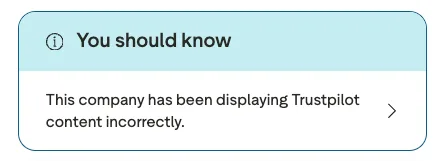
Customers visiting our profile were told:
“This company has been displaying Trustpilot content incorrectly.”
The seven days had not expired. We were still asking them to identify the problem.[8]
Trustpilot subsequently clarified that the star icon was not its asset or logo. In October, it also acknowledged that we had not copied its widget code.
Its objection was our own display linking to our Trustpilot profile.[9]
Then came the threat of a Cease and Desist notice and possible account termination.[11]
First came the public warning. Then came the demand to stop displaying the count and link.
05 · The count. The link. The notice.
The number is fine. The link is fine.
On 7 October, Trustpilot said the number and a plain link could each stay separately. The combination was the problem:
| What we display | Trustpilot’s response |
|---|---|
| “19,000+ reviews” without the profile link | Can stay |
| “See our reviews on Trustpilot” without a count or rating | Can stay |
| The review count linked to our profile | Legal threats[11] |
Trustpilot acknowledged that there is no specific clause in its published Guidelines stating that prohibition verbatim. It also confirmed that this was not a restriction based on being on the Free plan. We were on Advanced.
Its explanation:
“the requirement concerns the presentation and use of Trustpilot content rather than whether the number itself is factual.”
So we asked which contractual or other provision requires that accurate review count to be displayed only through an approved solution.
Then came the notice.
On 18 October, Trustpilot sent the cease-and-desist notice shown at the top of this page. It identified “19,000+ reviews on Trustpilot” with a direct profile link as the misuse. It still did not identify a specific clause establishing the count-plus-link prohibition.
“Remove the current custom implementation displaying Trustpilot content.”
“Use an authorized TrustBox available through your Trustpilot Business Account.”
What they say happens next
If they continue to detect what they call misuse after seven days, the notice says these measures will follow without further notice:
- Prominent consumer warning
- At least six months
- Our TrustScore
- Hidden during the warning
- Our business account
- Limited to replying to and flagging reviews
- Review data sent to search engines
- Trustpilot stops sharing it
It also says we would lose entitlement to Trustpilot brand assets and TrustBoxes, and reserves further legal action. These are the consequences threatened in the notice. The earlier public alert is already documented above.
We refuse to rent our reputation.
Our customers wrote those reviews about our work. We refuse to let thirteen years of their goodwill become a subscription we are afraid to cancel.
We took back our invitations. We removed the widgets. We declined the renewal. Our Google review requests cost £0 in platform fees, and our website display is our own work.
We still pointed customers towards the reviews. Trustpilot’s response now includes a cease-and-desist notice and threats to hide our score, restrict our account and put up a warning for at least six months.
For a small business, that is the pressure: years of customer goodwill on a platform that can put a warning above it while you are still asking what rule you broke.
Our reputation was earned by our staff and written by our customers. We refuse to rent it back.
Read the sources
1. Trustpilot’s own invitation figures. Under “Automate review collection”, Trustpilot’s partner sales page reports that businesses using automated review collection had a 15% higher average TrustScore and 105% more reviews in 2021 than businesses that did not. This compares company TrustScores, not individual review ratings. It is Trustpilot’s reported comparison, not an independent controlled study; the page does not provide the sample size or adjustment methodology. It does not establish that automation alone caused the difference, that paying caused it, or that AFS raised our score by 15%. Automated invitations are also available on the limited free plan. Our 43 automatically invited reviews and 4.9 score were recorded in our 29 May email, original thread, p. 13.
2. Near-perfect ratings. Northwestern’s Spiegel Research Center found product purchase likelihood typically peaked at ratings between 4.0 and 4.7, then fell towards 5.0. This does not establish an ideal score for our business or that any particular 4.9 is false.
3. The limits and the contract. Trustpilot confirms AFS is available on Free with 50 monthly invitations. Its paid plans offer higher limits. Its published terms, sections 6 and 35, describe usual twelve-month terms, automatic renewal and 30 days’ notice for direct subscriptions, subject to the agreed commercial terms.
4. Our correspondence and the price. Trustpilot refused standalone widgets on 10 June (original thread, p. 12), then offered Advanced at £495 plus VAT a month and API at £258.30 plus VAT a month: £753.30 monthly, billed quarterly, or £9,039.60 annualised before VAT (pp. 7 and 10). Including 20% VAT, the annual total is £10,847.52. This was a proposed combined package, not our existing bill or a widget-only price. Cancellation was requested on 10 June and confirmed on 11 June. On 11 and 17 June, Trustpilot recommended continuing its automatic invitations (pp. 8 and 11).
5. The AI pitch. Email of 27 May, original thread, p. 18; our dashboard analysis and challenge, pp. 12–15. Capgemini’s 58% finding concerns product and service recommendations. Our original reply wrongly suggested it had not used “replaced search engines” language; it had, in that specific context. Seer’s research compared profiles with different activity levels; it did not establish that paying caused the reported benefits. Referral clicks and AI recommendations are different measures.
6. Our traffic. Trustpilot’s email of 24 June, original thread, pp. 5–6, defined the 474,000 impressions and 440,000 views over six months as activity on our site. The excerpt from our reply is dated 5 August, p. 2.
7. The warning. Our 16 September reply is on p. 1 of the original thread. The separate brand-notice thread contains Trustpilot’s 28 September notice (p. 2) and our 29 September reply (p. 1). The notice gave examples of misuse without identifying a specific instance on our site. The dates establish the sequence, not Trustpilot’s motive. Both email threads are retained by Lock & Key; full copies contain personal contact details and are not published here.
8. The live alert. In its 29 September 2026 reply at 3:31pm, Trustpilot alleged unauthorised branding and specifically referenced our 19,000+ review display. It said we had not confirmed that we would remove or amend it and that it would proceed with a Consumer Alert. Our earlier reply that day had identified the icon as licensed Font Awesome artwork and requested the specific asset, intellectual property right and evidence behind the allegation. The reply did not supply those details. The publication email is shown as sent at 13:20 on 29 September; Trustpilot’s reply is displayed as 15:31. These are correspondence timestamps, not a verified time of banner publication. The screenshot records the warning displayed that day, before the seven days in the 28 September notice had elapsed. The supplied correspondence contains no intervening expired deadline. The notice also reserved the possibility of a warning for further use outside its guidelines; it did not expressly promise to withhold an alert for seven days. We retain the correspondence; personal contact details are not published here.
9. The reference/link clarification. In a subsequent reply, Trustpilot expressly said the concern was not ownership of the star icon, but the overall presentation and linking of Trustpilot on our site. It classified the display as a customized widget not permitted under our current plan, directed us to its approved website widgets, and requested removal of the reference/link. The supplied reply cites no specific contractual clause or brand-rule provision. This clarifies its stated objection; it does not establish a blanket prohibition on all links to Trustpilot or an admission that the earlier notice was withdrawn.
10. Profiles without signing up. Trustpilot’s explanation of profile creation and retention says profiles can be created automatically when a business web address is searched, or added from search results, and reviewed profiles generally remain unless its rules are breached. On 29 September 2026, the www.apple.com profile displayed 1.7 and the www.google.com profile displayed 2.3. Both were labelled unclaimed, with no history of asking for reviews and a warning about representativeness. These are snapshots of those specific profiles, not proof of either company’s wider relationship with Trustpilot or that non-participation caused the scores. Our comparison with small businesses is our assessment of the reputational pressure.
11. October enforcement correspondence. Trustpilot’s 3 October 2026 email, request #03662766, acknowledged the Font Awesome icon and independent implementation, maintained its objection to presentation and linking under our plan, and warned of a possible Cease and Desist notice and account termination. It separated our proposed future use of customer review text from the current presentation dispute. Our 4 October reply requested the specific contractual provision and its application. On 6 October, Trustpilot repeated its approved-display/API position and described that day as the final day of the compliance period. On 7 October, it said a factual review count could remain without the profile link, or a plain “See our reviews on Trustpilot” link could remain without a count or rating. Its later reply that day acknowledged no specific clause in the published Guidelines states the count-plus-link prohibition verbatim, and confirmed this was not a restriction based on being on the Free plan: we were on Advanced. It maintained that the combined display was not an approved format. This is not an admission that no broader provision applies. Our reply asked which contractual or other provision requires approval for this particular use. The later issued notice is documented in source 12. The 29 September 3:48pm warning had also threatened a Cease and Desist notice and gave a further seven days for changes.
12. The issued cease-and-desist notice · 18 October 2026. Trustpilot’s email is headed “Cease and Desist Notice: Breach of Trustpilot Legal Brand Guidelines (Misuse of the Trustpilot Brand)”. It identifies “19,000+ reviews on Trustpilot” with a direct profile link as the alleged misuse. The screenshot reproduced at the top is the attachment supplied with that notice, preserved unchanged and served through our CDN. The notice invokes the Legal Brand Guidelines and business terms generally, but does not identify a specific clause establishing the count-plus-link prohibition. It is a demand from Trustpilot, not a court order.
Read the notice’s demand and threatened consequences
“The website continues to display Trustpilot branding, including the text ‘19,000+ reviews on Trustpilot’ with a direct link to the Trustpilot profile”
“Remove the current custom implementation displaying Trustpilot content.”
“Use an authorized TrustBox available through your Trustpilot Business Account.”
“We do not tolerate misuse of the Trustpilot Brand, and you must immediately cease and desist doing this. This is your final warning.”
“If we continue to detect misuse of the Trustpilot brand on www.lockandkey.co.uk in 7 days, we will, without further notice to you:”
- “Place a prominent Consumer Warning on your business profile page for a minimum of 6 months, during which your TrustScore will be hidden.”
- “Your Trustpilot Business account will be limited to replying to and flagging reviews.”
- “You’ll no longer be entitled to use any of the Trustpilot brand assets and TrustBoxes.”
- “Stop sharing your Trustpilot review data with search engines.”
“We reserve the right to take further and appropriate legal action to protect the integrity of our platform and our brand.”
Where we stand · Display updated 22 October 2026. Our review panel shows a combined total across platforms, with a separate link to our older Trustpilot reviews. We have not accepted Trustpilot’s allegation. The account above now includes its issued notice of 18 October; the additional sanctions it describes are threatened consequences, not confirmed outcomes. Our alternative uses Google review links and our own development work. We will publish corrections or further substantive responses here.